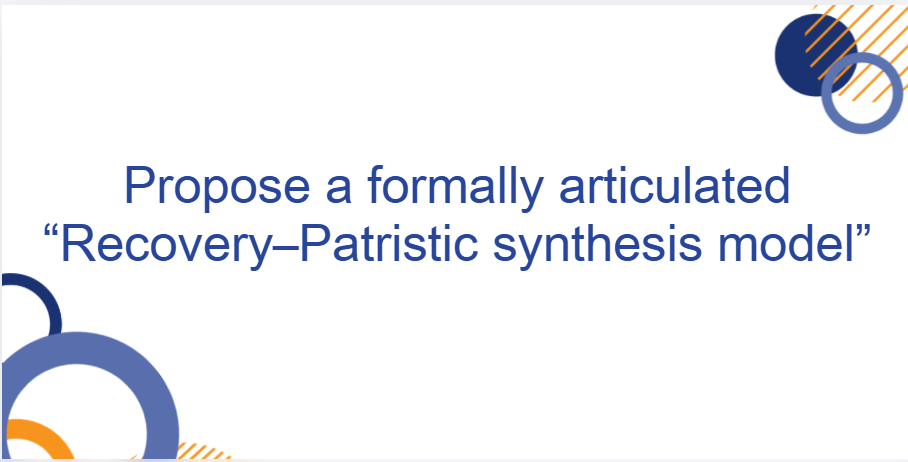
Below is a formally articulated “Recovery–Patristic Synthesis Model” of the economic Trinity, written in systematic–constructive academic style, suitable as:
- a constructive proposal section in a journal article,
- a doctoral chapter, or
- a theological position paper responding to modalism / experientialism critiques.
The goal is integration, not compromise: retaining patristic doctrinal safeguards while preserving the Recovery tradition’s economic and experiential strength.
A Recovery–Patristic Synthesis Model of the Economic Trinity
I. Methodological Premise
1. Governing Principle
The Trinity is known ontologically as God is in Himself, but is accessed epistemologically and participated in economically as God is for us.
This model affirms:
- Nicene ontology (against modalism),
- patristic economy (against abstraction),
- Recovery experiential economy (against doctrinal sterilization).
II. Conceptual Framework: Three Irreducible Levels
Level 1:
Immanent Trinity
(Ontology)
- God as Father, Son, Spirit in eternal relations of origin
- Categories:
- ousia (essence)
- hypostases (persons)
- eternal generation & procession
- Not directly experienced
- Not bypassed or denied
 Patristic anchor: Cappadocians, Augustine
Level 2:
Economic Trinity
(Revelation & Mission)
- God’s self-disclosure in history
- Missions of:
- the Son (incarnation)
- the Spirit (indwelling)
- Economy reveals without exhausting ontology
Patristic anchor: Irenaeus, Athanasius
Recovery emphasis: “God’s economy”
Level 3:
Experiential Trinity
(Participation & Dispensing)
- God as received, enjoyed, and lived by believers
- Trinity experienced:
- economically
- organically
- corporately
Patristic parallel: Divine energies (Palamas)
Recovery vocabulary: dispensing, flowing, enjoyment
III. Core Structural Thesis
Thesis Statement
The Recovery model articulates the experiential extension of patristic economic Trinitarianism, while patristic theology supplies the ontological grammar required to safeguard it.
IV. Trinitarian Structure in the Economy (Synthesized)
1. Father – Source (
arche
)
- Eternal source in ontology
- Initiator in economy
- Origin of divine dispensing
 Patristic: Monarchy of the Father
Recovery: Source of life
2. Son – Embodiment (
Logos incarnatus
)
- Eternal Word
- Incarnate mediator
- Embodiment of divine fullness (Col 2:9)
Patristic: Incarnation & recapitulation
Recovery: Embodiment of the Triune God
3. Spirit – Realization (
energeia / applicatio
)
- Eternal procession
- Economic indwelling
- Experiential realization of Christ
Patristic: Divine energies
Recovery: “Realization” without ontological confusion
V. Key Terminological Clarifications (Critical to the Synthesis)
1. “Process” ≠ Ontological Change
- Patristic: missions reveal relations
- Recovery: “process” refers to economic movement, not change in being
Formal clarification:
Process = economy of manifestation, not mutation of essence
2. “Mingling” ≠ Mixing
- Equivalent to:
- perichoresis (coinherence)
- participation without confusion
- Humanity remains human; divinity remains divine
Chalcedonian safeguard:
Without confusion, change, division, or separation
3. “Dispensing” ≠ Impersonal Distribution
- Personal self-giving of the Triune God
- Analogous to:
- Eastern participation
- Western indwelling by grace
VI. Soteriological Integration
| Aspect | Patristic | Recovery | Synthesis |
|---|---|---|---|
| Salvation | Deification | Life impartation | Participatory life |
| Means | Energies | Dispensing | Economic participation |
| Goal | Union | Enjoyment | Corporate expression |
VII. Ecclesiological Horizon
Church as Economic Outcome
The church is the corporate, experiential expression of the Triune God’s economy.
- Not merely forgiven individuals
- Not merely mystical participation
- But built-up Body of Christ
Patristic root: Totus Christus
Recovery development: Body-building ecclesiology
VIII. Eschatological Consummation
New Jerusalem as Final Economy
- Ontology remains transcendent
- Economy reaches completion
- Participation becomes corporate fullness
Synthesis claim:
The New Jerusalem is the consummated economic Trinity expressed in redeemed humanity—without collapsing Creator and creature.
IX. Strengths of the Synthesis Model
- Doctrinally orthodox (Nicene–Chalcedonian)
- Experientially viable (daily Christian life)
- Ecclesiologically concrete
- Ecumenically translatable
- Biblically grounded
X. Remaining Theological Tasks
To mature this synthesis academically:
- Map Recovery terms explicitly to patristic categories
- Develop a formal pneumatology dialogue with Palamas
- Clarify epistemological vs. ontological priority
- Engage Rahner’s Rule critically
XI. Concluding Theological Judgment
The Recovery–Patristic synthesis demonstrates that experiential Trinitarian theology need not be anti-metaphysical, and metaphysical Trinitarian theology need not be experientially sterile. When economy, ontology, and participation are properly distinguished yet inseparably related, the Trinity is confessed not only as true doctrine, but as lived reality.
If you wish, I can next:
- Condense this into a 1,200-word journal submission
- Translate it into high-register Chinese theological prose
- Add formal definitions and footnotes
- Draft a response letter to peer reviewers
Just tell me your next move.