Every second, your body is monitoring the environment for potential danger. When a threat appears, a powerful biological control system activates instantly. Within moments, multiple organs communicate, hormones are released, metabolism changes, and the body prepares for action.
This system is known as the human stress response, and it operates through an extraordinary network called the HPA axis — the hypothalamus–pituitary–adrenal axis.
It is one of the most precisely coordinated systems in human biology.
Step 1 — The Brain Detects Danger
Everything begins in the brain.
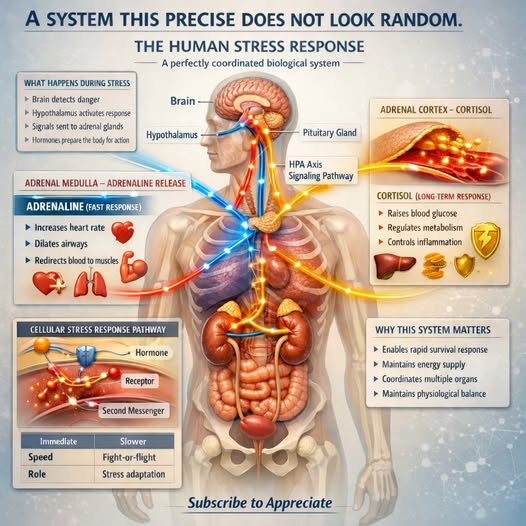
When the brain perceives danger—whether physical or psychological—the hypothalamus immediately activates the stress response.
The hypothalamus sends signals to the pituitary gland, which then communicates with the adrenal glands sitting on top of the kidneys.
Within seconds, a cascade of biological signals begins moving through the body.
This is not a single reaction.
It is a multi-layered communication network involving nerves, hormones, and cellular signaling.
Step 2 — Adrenaline: The Immediate Response
The adrenal glands contain two major regions.
The inner region, called the adrenal medulla, releases adrenaline (epinephrine) into the bloodstream.
Adrenaline triggers the classic fight-or-flight response.
Almost instantly:
• Heart rate increases
• Airways widen to bring in more oxygen
• Blood is redirected toward muscles
• Alertness and focus rise dramatically
All of this happens in seconds.
Your body becomes temporarily optimized for survival.
Step 3 — Cortisol: The Sustained Response
While adrenaline acts quickly, the outer layer of the adrenal gland—the adrenal cortex—releases another hormone called cortisol.
Cortisol works more slowly but provides long-term support during stress.
Its effects include:
• Increasing blood glucose for energy
• Regulating metabolism
• Controlling inflammation
• Maintaining energy supply during prolonged stress
This hormone ensures that the body can sustain activity when challenges last longer than a few moments.
Step 4 — Communication at the Cellular Level
The coordination does not stop at organs.
Inside individual cells, hormones bind to specialized receptors embedded in the cell membrane. These receptors trigger intracellular signaling pathways.
Signals travel through molecular messengers, eventually reaching the cell nucleus, where specific genes can be activated.
This means the stress response can influence:
• metabolism
• immune function
• energy production
• cellular repair
Even at the microscopic level, the system is tightly organized.
Why This System Matters
Without the stress response, survival would be extremely difficult.
This system:
• allows rapid reaction to danger
• maintains energy supply during crisis
• coordinates multiple organs simultaneously
• helps the body return to balance after stress passes
The heart, lungs, brain, immune system, and metabolism all work together through this network.
A Remarkable Biological Control System
The human stress response is not a simple reaction.
It is a layered biological control network involving:
• neural signaling
• hormonal communication
• cellular signaling pathways
• organ-level coordination
Every part must function in harmony for the system to work properly.
From the brain detecting danger to hormones reaching distant cells, the level of coordination inside the body is astonishing.
Subscribe to Appreciate
for more insights into the remarkable systems found within the human body.