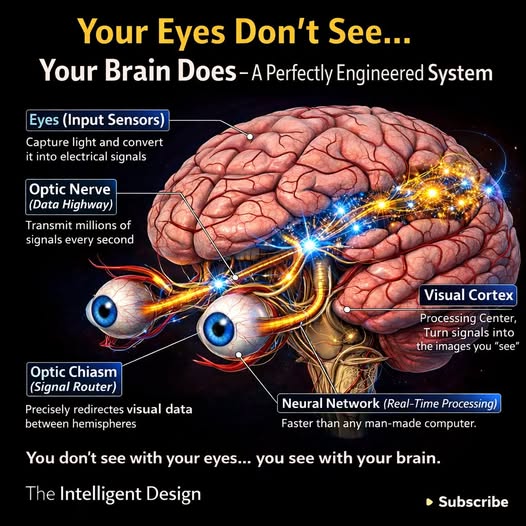
they detect light. Photons enter the eye, hit the retina, and are converted into electrical signals. That’s where their job ends. What you experience as sight — color, depth, motion, faces, meaning — is constructed inside your brain. In other words, vision is not just a function of the eye, but a coordinated system between eye and brain working in perfect synchronization.
Those electrical signals travel through the optic nerve, a dense bundle carrying millions of impulses every second. At the optic chiasm, something remarkable happens: signals from each eye are precisely split and rerouted so that both hemispheres of the brain receive coordinated visual information. This allows you to perceive depth, judge distance, and maintain a stable image of the world — all in real time.
Once the signals reach the visual cortex, the brain begins decoding them instantly. It identifies edges, patterns, colors, movement, and even faces in a fraction of a second. There’s no conscious effort involved. You don’t “compute” what you’re seeing — it simply appears as a complete, meaningful image. This level of processing happens faster than any man-made system, with billions of neurons firing in highly organized networks.
What makes this system even more astonishing is its precision and reliability. Every time you open your eyes, the same process repeats flawlessly. There is no lag, no confusion, no breakdown in communication between components. The eyes, optic nerves, neural pathways, and brain regions are not independent parts — they function as a unified system, each dependent on the other to produce vision.
This raises an important question. Systems that rely on multiple interdependent parts typically require coordination. The eye alone cannot produce vision. The brain alone cannot receive visual data without the eye. The pathways must exist, the signals must be encoded correctly, and the processing centers must interpret them accurately — all at once. The system only works when everything is in place.
When you step back and consider this, vision looks less like a simple biological feature and more like a highly integrated information-processing system. From capturing light to constructing reality in your mind, every step reflects a level of precision that continues to fascinate scientists. The deeper we study it, the more we realize: you don’t just have eyes — you have a system that turns light into sight, instantly and effortlessly.
And that system is running inside you every second of your life.