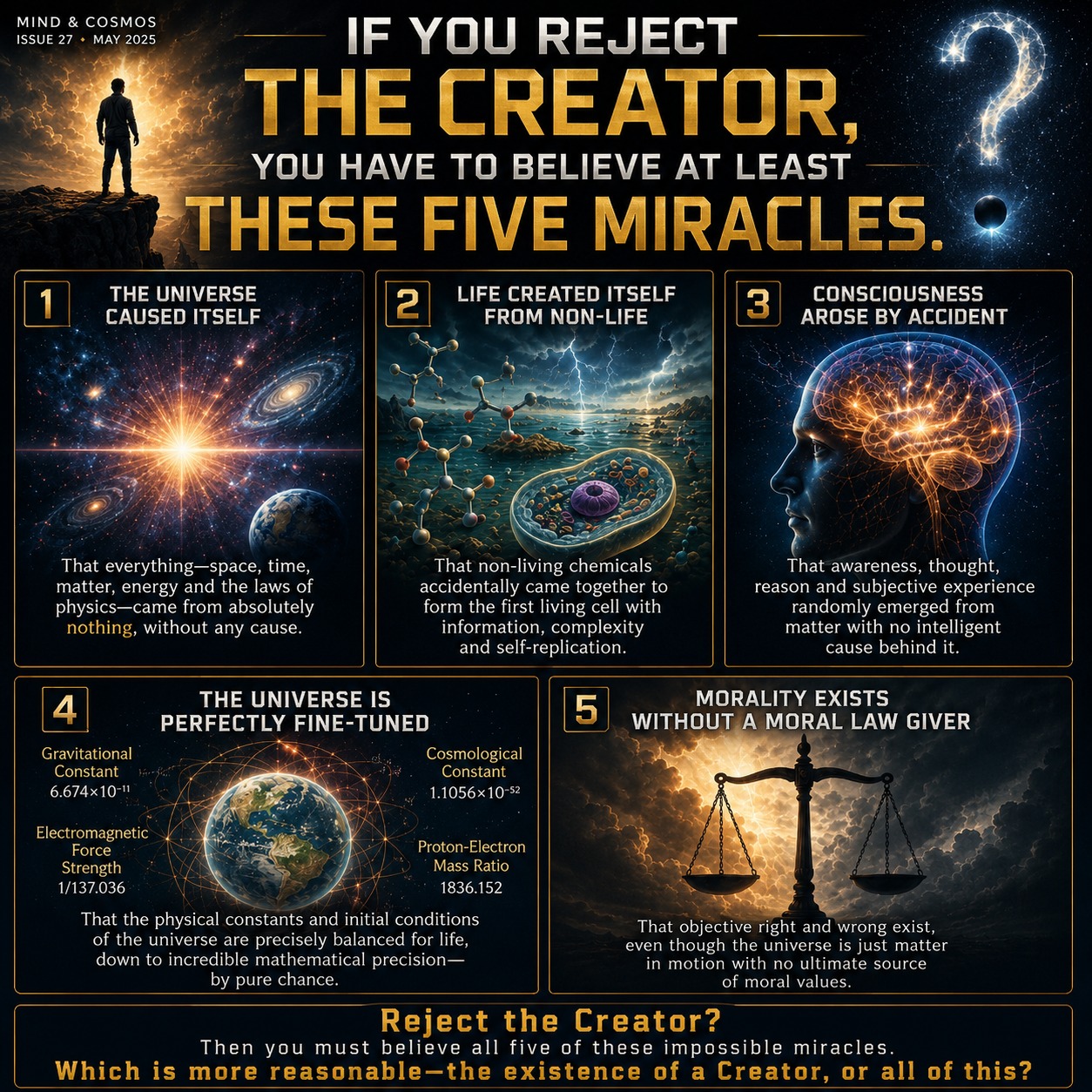
For many people, belief in a Creator is often portrayed as the extraordinary claim. But when we step back and examine the complexity of existence itself, another question emerges: What assumptions are required if there is no guiding intelligence at all? The deeper science explores the universe, life, consciousness, and the laws of nature, the more astonishing these realities appear.
The first question is the origin of the universe itself. Modern cosmology strongly supports that the universe had a beginning. Space, time, matter, and energy all appear to have come into existence together. The laws of physics themselves seem finely structured from the very first moments of cosmic history. This leaves a profound mystery: why is there something rather than nothing? Why do mathematical laws exist at all? And why is the universe intelligible to the human mind? Many scientists and philosophers argue that a beginning to the universe naturally points toward a cause beyond the universe itself.
Then there is the mystery of life. Even the simplest living cell contains extraordinary levels of organized information, molecular machinery, error correction systems, and self-replication. DNA functions like a digital code. Proteins fold with astonishing precision. Molecular motors inside cells transport cargo like microscopic machines. Life is not just chemistry—it is chemistry organized with information and purpose-like coordination. Despite decades of research, science still has no confirmed natural explanation for how non-living chemicals transformed into the first self-replicating living organism. The origin of biological information remains one of the greatest unresolved scientific questions.
Consciousness adds another layer of mystery. Human awareness is more than electrical signals alone. We experience thoughts, emotions, creativity, reasoning, imagination, morality, and self-awareness. We can reflect on our own existence and contemplate the cosmos itself. Yet no one fully understands how subjective conscious experience could emerge purely from particles and chemical reactions. Why should matter become aware of itself? Why does the universe contain beings capable of understanding mathematics, music, beauty, truth, and meaning?
The fine-tuning of the universe is another remarkable observation. Many physical constants appear to exist within incredibly narrow ranges that allow stars, chemistry, planets, and life to exist. If gravity were slightly stronger or weaker, stars could not function properly. If the electromagnetic force changed, atoms and molecules would not behave in life-permitting ways. If the expansion rate of the universe differed even slightly, galaxies might never form. Physicists continue debating the implications of this fine-tuning, but many agree that the precision is extraordinary. The universe appears not merely chaotic—but ordered, structured, and mathematically elegant.
And then there is morality. Across cultures and civilizations, humans recognize concepts like justice, cruelty, love, sacrifice, honesty, and evil. People may disagree on details, but the sense that some actions are objectively wrong and others objectively right appears deeply rooted in human nature. This raises a philosophical question: if morality is only the product of survival instincts or social evolution, why do humans experience moral truths as something greater than personal preference? Why do concepts like justice and human dignity feel objectively meaningful?
None of these questions alone “prove” a Creator in a laboratory sense. Science is powerful at explaining mechanisms within nature, but questions about ultimate origins, meaning, consciousness, and why laws exist at all move beyond simple material measurements. What these observations do show is that reality is far more profound than many people assume. The universe is filled with astonishing order, information, precision, beauty, and intelligibility.
Whether one believes in God, intelligent design, or purely naturalistic explanations, these questions deserve thoughtful reflection—not ridicule. The deeper we explore nature, the more extraordinary existence itself becomes. From galaxies and physical laws to DNA and consciousness, reality continues to inspire awe.
And perhaps that awe is itself worth paying attention to.
IF YOU REJECT THE CREATOR, YOU HAVE TO BELIEVE AT LEAST THESE FIVE MIRACLES.