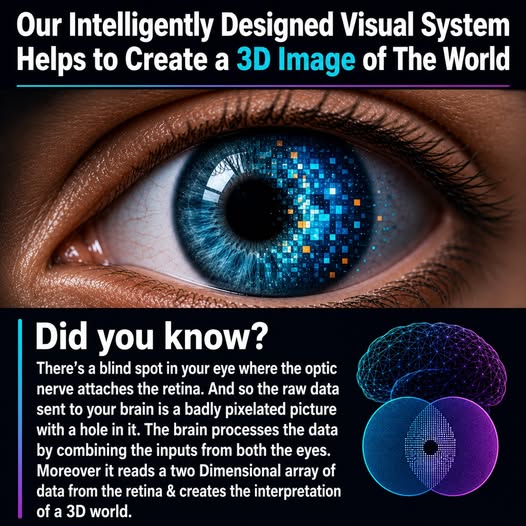
There’s actually a blind spot in each of your eyes where the optic nerve connects to the retina. In that small area, there are no light-detecting cells at all. That means part of the visual information is literally missing. Yet you never notice a black hole floating in your vision.
Why?
Because your brain constantly fills in the missing information by combining data from both eyes, comparing patterns, predicting shapes, and reconstructing the scene around you in real time. What you “see” is not a raw camera feed. It is a highly advanced interpretation created by your visual system.
Even more fascinating, the image formed on your retina is only two-dimensional. Light enters through the cornea and lens, gets focused onto the retina, and is converted into electrical signals by millions of specialized photoreceptor cells called rods and cones. These signals travel through the optic nerve to the visual cortex in the brain, where depth, motion, color, shape, and spatial awareness are processed together.
Your brain then turns that flat stream of data into a rich 3D experience of reality.
This entire process happens almost instantly — billions of neural calculations every moment — allowing you to recognize faces, judge distances, read text, navigate space, and react to movement with incredible precision.
The human visual system is not just powerful. It is unbelievably sophisticated.
A system this advanced, coordinated, and information-rich continues to amaze scientists, neuroscientists, and engineers alike.
The more we discover about the eye and the brain, the more extraordinary the design appears.